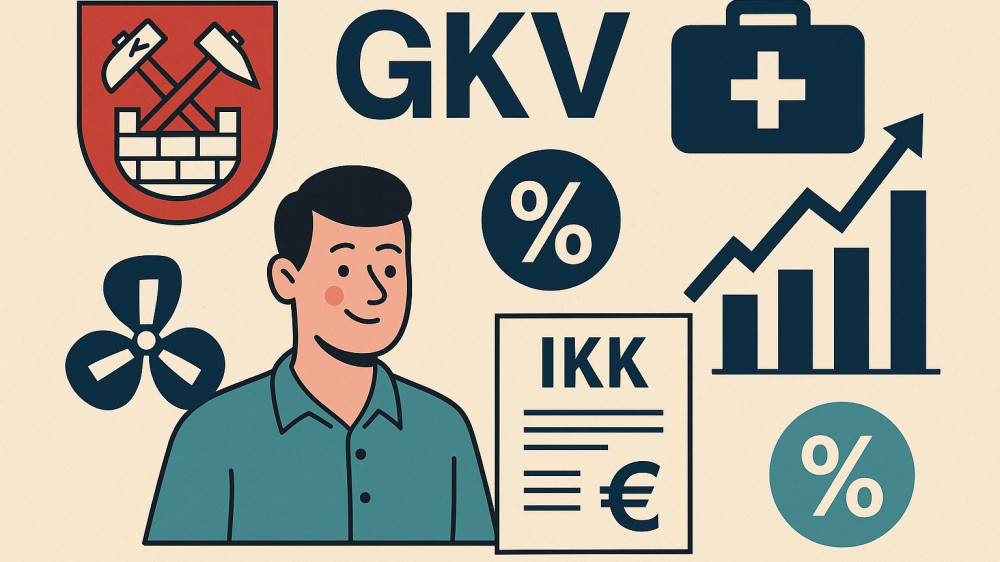
Innungskrankenkassen (IKK) in 2025: Membership, Contributions, and Market Role
Within Germany's public health insurance (Gesetzliche Krankenversicherung - GKV) system, the Innungskrankenkassen (IKK) hold a unique place. Rooted in the medieval guilds of craftsmen and tradespeople, these funds have evolved from closed, profession-based societies into open, competitive insurers. For American readers, think of them as similar to historically trade union-affiliated health plans that have opened their doors to the general public, now competing within a regulated marketplace like Medicare Advantage plans. This guide provides a complete snapshot of all active IKKs as of January 1, 2025, detailing their membership trends and financial standing.
The IKK Evolution: From Craft Guilds to Open Competition
The story of the Innungskrankenkassen begins with the craft guilds of the Middle Ages, where members pooled resources for mutual aid during illness or injury. This principle was formalized into the statutory system in the late 19th century. For decades, if you worked in a member craft business, you were required to be insured with its corresponding IKK.
The game-changer was the 1996 reform introducing free choice of health fund. IKKs could now open to all publicly insured individuals, but this also thrust them into intense competition. The result was massive consolidation: from around 178 funds in 1970 to just six active Innungskrankenkassen in 2025. Despite their reduced number, these remaining IKKs are significant players, collectively insuring about 5.1 million people, representing a 6.9% market share in the GKV. They are known for often combining historical service ethos with modern, member-focused approaches.
All Active Innungskrankenkassen (IKK) - 2025 Data Overview
The following table lists every active IKK as of January 1, 2025, with key performance indicators. The additional contribution (Zusatzbeitrag) is a crucial monthly cost factor beyond the standard 14.6% income contribution. Member change indicates the fund's competitiveness and appeal in the prior year.
| IKK Name | Total Members (Jan 1, 2025) | Change vs. Previous Year | Additional Contribution (2025) | Notes & US Market Analogy |
|---|---|---|---|---|
| IKK classic | ~3,000,000 | Data from full report* | Data from full report* | The largest IKK, operating nationwide. Comparable to a large, national non-profit health plan with historical roots in specific industries. |
| IKK gesund plus | Data from full report* | Data from full report* | Data from full report* | A major IKK with a significant regional presence. Similar to a strong regional health insurer known for customer service. |
| IKK Brandenburg und Berlin | 220,603 | Data from full report* | Data from full report* | The smallest IKK, focused on its specific region. Analogous to a local community-based health plan prized for personalized service. |
| IKK Südwest | Data from full report* | Data from full report* | Data from full report* | Serves the southwestern federal states. Like a regional Medicare Advantage plan with deep local network ties. |
| IKK Nord | Data from full report* | Data from full report* | Data from full report* | Operates in northern Germany. Comparable to a health insurer serving a distinct geographic area with tailored programs. |
| Die IKK (e.g., IKK gesund und fit) | Data from full report* | Data from full report* | Data from full report* | Another active IKK entity. Represents the diversified nature of the remaining guild funds in the modern market. |
*Precise member change figures and 2025 additional contribution rates for each IKK are detailed in the complete dataset from the professional journal "Beiträge zur Gesellschaftspolitik" (BzG), Issue 05-25. The trend shows IKKs actively competing on both contribution levels and service quality.
Key Trends and What They Mean for You
- Consolidation for Stability: The drastic reduction in IKK numbers reflects a market-wide trend in German public health insurance. Remaining funds are larger, more financially robust, and offer extensive nationwide or regional networks.
- Service as a Differentiator: Many IKKs consistently score high in customer satisfaction surveys (as seen in our family-friendly insurer analysis). Their historical focus on a specific community often translates into strong member service and support.
- Competitive Contributions: While not always the absolute cheapest, IKKs often position their additional contribution competitively, aiming to offer good value through a combination of rate and service.
- Open to All: You no longer need to be a carpenter or electrician to join. Any eligible individual in the public insurance system can choose an IKK, making them a viable option during the annual switching period.
Considering an IKK for Your Health Insurance?
If you're evaluating German public health insurance options, an Innungskrankenkasse can be a compelling choice. Here’s how to proceed:
- Compare Directly: Obtain detailed quotes from 2-3 IKKs alongside other fund types (AOK, BKK, Ersatzkassen). Compare their specific voluntary benefits (Satzungsleistungen) for areas important to you, like alternative medicine, health apps, or preventive care bonuses.
- Check Regional Strength: If you prefer a local presence, a regionally focused IKK like IKK Brandenburg und Berlin might offer more personalized service.
- Review Satisfaction Data: Consult independent customer satisfaction and service test results to see how your shortlisted IKKs perform in real-member assessments.
The Innungskrankenkassen represent a blend of tradition and modernity in German healthcare. Their continued presence underscores that in a competitive market, a strong service ethos and member trust remain powerful assets.
Source: Member statistics are sourced from the professional journal "Beiträge zur Gesellschaftspolitik" (BzG), Issue 05-25. The complete evaluation is available via the MC.B publisher's website. Contribution rates are based on the official overview from the GKV-Spitzenverband.