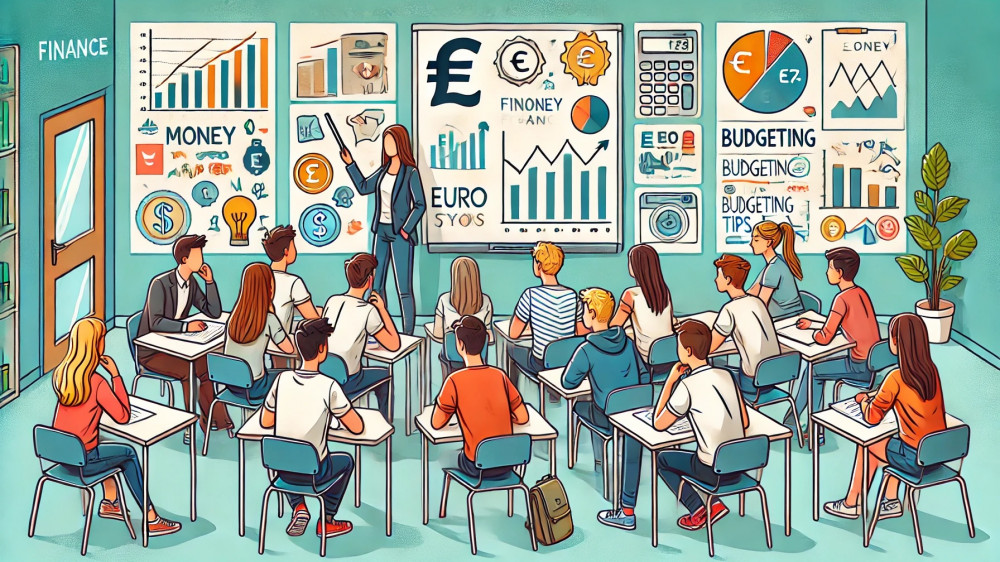
Building Financial Literacy: Why Schools, Parents, and Communities Must Work Together
How prepared are you—or the young people in your life—to make sound financial decisions? In Germany, a significant gap in financial literacy among youth is raising alarms. While 85% of Germans support more financial education in schools, the challenge is more complex than adding a single subject to the curriculum. Without a solid understanding of concepts like investing, credit, and inflation, young adults risk making poor financial choices or falling for dubious online schemes. This article explores the limitations of a school-only approach and outlines the multi-faceted strategy needed to equip the next generation with essential money management skills.
The Case for (and Against) a Dedicated School Subject
A dedicated school subject like "Financial Education" could systematically teach saving, investing, and responsible money management. Karolin Schriever, Executive Board Member of the German Savings Banks Association (DSGV), emphasizes its importance: "We see financial literacy as a cornerstone for social participation and economic independence. Especially in times of increasing economic uncertainty, young people need the right tools to make financial decisions confidently."
However, significant hurdles exist. School curricula are already overloaded, and there is a shortage of teachers qualified in this specific field. There's also a risk that financial knowledge could become a dry theoretical exercise with little practical relevance for students' daily lives.
The Stark Reality: What Young People Don't Know
The knowledge gap has tangible consequences. A 2022 survey by the German Banking Association revealed that only 45% of 16- to 24-year-olds understand the term "inflation," despite its recent surge. More alarmingly, only about one in three teenagers knows what an "investment fund" is, and a mere 17% can explain what an ETF (Exchange-Traded Fund) is. This lack of knowledge creates vulnerability.
The Digital Threat: Vulnerability to Online Scams
This financial illiteracy makes young people easy targets for questionable online offers. Influencers and financial service providers lure them with unrealistic promises like "guaranteed returns with no risk!" or "get rich in three months!" Many of these schemes lead to expensive subscriptions or outright financial losses, highlighting the urgent need for critical financial thinking and consumer protection skills.
The Crucial Role of Parents and the Home Environment
Beyond the classroom, the home environment plays a decisive role. Children learn best through practical experience: planning a household budget, setting joint savings goals, or discussing the purpose of insurance. However, many parents lack the knowledge, confidence, or time to provide this guidance. This dynamic exacerbates social inequality: children from financially savvy households often acquire knowledge early, while those from less advantaged backgrounds may be left to figure it out alone.
Towards a Holistic Solution: Combining School, Home, and Community
A promising approach is a combination of in-school and out-of-school offerings. Non-profit organizations, banks, and independent financial experts already provide workshops where young people can learn practical financial skills. However, these programs are often not available nationwide, particularly in rural or socio-economically disadvantaged areas. Furthermore, as voluntary programs, they typically reach only those already motivated to learn, missing the very individuals who need them most.
Key Recommendations for Effective Financial Education
- Integrate, Don't Just Add: Embed financial concepts into existing subjects like math, social studies, and economics to make learning contextual and practical.
- Empower Parents: Provide accessible resources and workshops for parents to build their own financial knowledge and confidence to guide their children.
- Leverage Community Partnerships: Schools should actively partner with local banks, credit unions, and non-profits to bring real-world experts and programs into the classroom.
- Focus on Digital Literacy: Teach students to critically evaluate online financial content, recognize scams, and understand digital payment and investment platforms.
- Ensure Equity of Access: Policymakers should fund and promote financial literacy programs specifically designed to reach underserved communities.
Building a financially literate generation is not a task for schools alone. It requires a concerted effort from educators, parents, community organizations, and policymakers. By creating a supportive ecosystem around young people, we can provide them with the financial knowledge and critical skills necessary to navigate an increasingly complex economic world and achieve long-term financial security.
Insurers and brokers are struggling in claims management with high backlogs, increasing claim frequencies, a shortage of skilled workers, and growing customer expectations. Manual processes are expensive and slow.