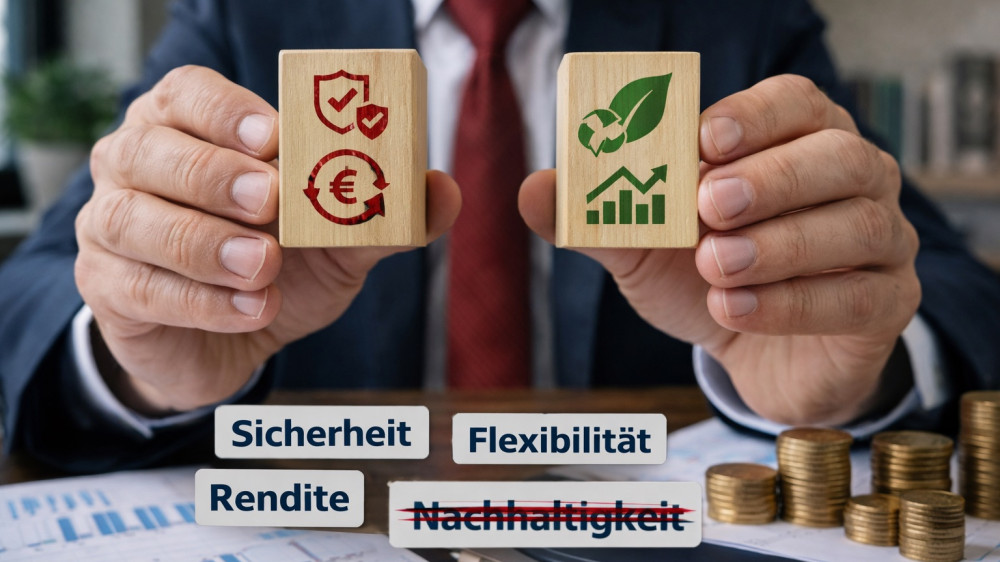
You might think that sustainability is taking over the investing world—but a new study from BarmeniaGothaer shows that for most German investors, it's still not the top priority. While 53% of respondents say sustainability is important when investing (up slightly from 50% last year), only 8% call it their most important factor. Instead, classic priorities like safety, flexibility, and returns continue to dominate. For you, this means that while ESG (Environmental, Social, and Governance) investing is growing, it's still a secondary consideration for most people.
Advertorial
“The study makes clear: despite current geopolitical uncertainties, sustainability remains an important factor for the majority of Germans in their investment decisions,” says Anton Buchhart, board member of BarmeniaGothaer Asset Management. However, sustainability is rarely the deciding factor. Only 8% of respondents name sustainable criteria as the most important aspect of their investments. Far more weight is given to traditional factors like safety, flexibility, and returns—which still largely determine investment choices and reflect the need for stability and predictability. This is similar to how many U.S. investors prioritize retirement security (like a 401(k) or IRA) over ESG funds, even as sustainable options become more available.
Still, the willingness to sacrifice returns for sustainability exists: 51% of respondents would be willing to do so, while 45% would not. For Buchhart, this apparent conflict is relative: “Sustainability and returns are not mutually exclusive—on the contrary: considering sustainability criteria can also help reduce risk and thus limit negative impacts on returns.” In well-structured portfolios, the question of sacrifice often doesn't even arise. For you, this means that ESG investing doesn't have to mean lower returns—especially if you choose funds that integrate sustainability as a risk management tool.
Interestingly, German investors don't view sustainability only through an environmental lens. Social aspects are increasingly coming to the forefront. 38% of respondents name social justice as the most important component of sustainable investing, followed by environmental and climate protection at 33%. A quarter of investors see responsible corporate governance as crucial. This shows a broader understanding of sustainability that goes beyond classic environmental issues. For U.S. investors, this mirrors the growing interest in socially responsible investing (SRI) and impact investing, where factors like labor practices, diversity, and corporate ethics matter as much as carbon footprints.
“Sustainability is not a short-term trend, but an expression of changing values,” Buchhart emphasizes. “Capital investment is increasingly seen as part of social responsibility.” Especially against the backdrop of geopolitical tensions and economic uncertainty, this aspect is gaining importance. Investment decisions are no longer made solely based on financial metrics but increasingly in the context of social and corporate reliability. For you, this means that aligning your portfolio with your values can also provide a sense of purpose and stability.
At the same time, navigating the market remains a challenge for many investors. Distinguishing between genuinely sustainable products and pure “green marketing” isn't always easy. Buchhart recommends paying attention to regulatory classifications and qualitative criteria: “The classification of a fund under the Disclosure Regulation can provide initial clues. Voluntary, reputable ESG labels also offer guidance. However, for a well-founded assessment, it's worth taking a close look at a fund's documentation.” Personal advice remains an important building block for sensibly linking individual investment goals and product choice. In the U.S., you might look for funds with clear ESG ratings from MSCI or Sustainalytics, or consult a financial advisor who specializes in sustainable investing.
Self-employed professionals often take charge of their work and life—and their retirement should be no different. For an efficient, returns-focused plan, add smart investing to your bucket list. Learn how to balance safety and growth for a secure financial future.
| Aspect | German Investors (Study Findings) | What This Means for U.S. Investors |
|---|---|---|
| Top Priority | Safety, flexibility, returns (only 8% choose sustainability) | Retirement security and growth still dominate; ESG is secondary |
| Importance of Sustainability | 53% say it's important; 18% very important | Growing interest, but not yet a deal-breaker for most |
| Willingness to Sacrifice Returns | 51% would accept lower returns for sustainability | Similar split; many see ESG as risk management, not a trade-off |
| Definition of Sustainability | Social justice (38%), environment (33%), governance (25%) | Broadening to include social and governance factors (SRI/impact) |
| Challenge | Distinguishing real ESG from green marketing | Look for regulatory labels, ESG ratings, and advisor guidance |
In summary, while sustainability is a growing consideration for investors, it hasn't replaced the traditional pillars of safety, flexibility, and returns. For you, the key is to find a balance that aligns with your values without sacrificing your financial goals. By focusing on well-structured portfolios that integrate ESG criteria as part of risk management—and by seeking transparent, well-rated funds—you can invest with both your head and your heart.