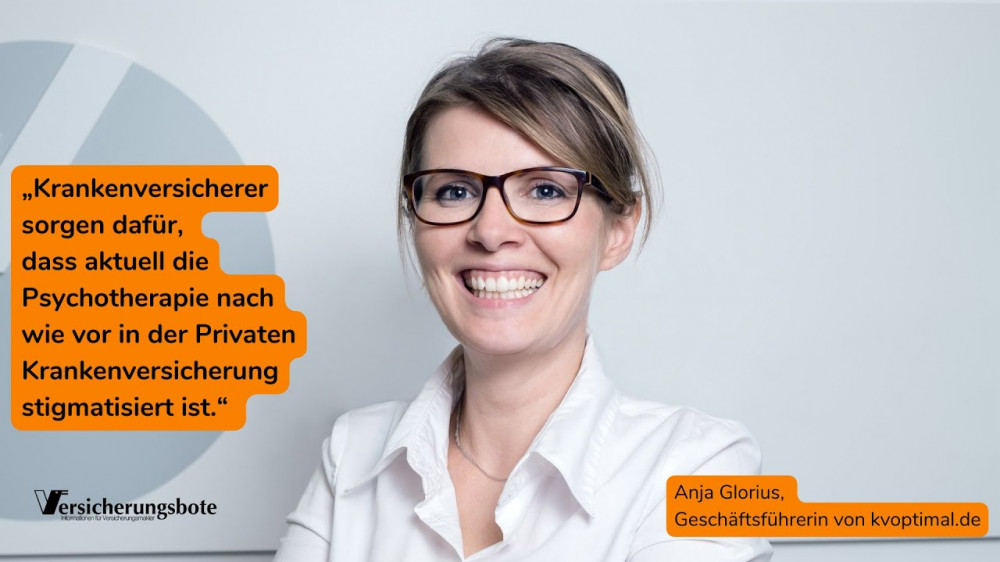
Private Health Insurance and Psychotherapy: Why German Insurers Struggle with Mental Health Coverage
Anja Glorius is a certified insurance and finance specialist focusing on health insurance. The managing director of tariff switching specialist KVoptimal.de explains in a Versicherungsbote interview why students should obtain private health insurance (PKV) options as early as possible—and why the PKV industry still has catching up to do regarding "psychotherapy" coverage. Her insights reveal critical challenges and opportunities for insurance professionals advising clients on mental health protection.
The Disclosure Dilemma: What Counts as Psychotherapeutic Treatment?
Private health insurers typically ask applicants about psychotherapeutic treatments received over the past ten years. When asked what qualifies as such treatment, Glorius clarifies: "Basically, as with all health questions: You answer what you're asked. Most insurers ask quite generally about psychotherapeutic treatments and not about the illness value. This would ultimately mean: you'd even have to disclose things like marriage or couples therapy or professional coaching—that's often what it's called when you go to a psychotherapist due to a professional situation because you think: I don't handle stress situations well. How can I better resolve this with colleagues? These are all subject areas falling under this question. And if I don't disclose them, then I might have to face consequences later."
This broad interpretation creates significant challenges for applicants, particularly as mental health awareness and preventive care become more normalized.
Industry Response: Lagging Behind Societal Change
Regarding how private health insurers handle applicants who have received psychological treatment, Glorius offers a frank assessment: "Currently, if expressed very casually, private health insurance still handles this very backwardly. That means: From my perspective, nothing at all has changed in these areas since the 2000s. That means we've changed societally—the 'psychotherapy' drawer isn't quite as big and not as stigmatized—but private health insurance hasn't arrived there at all. Especially after short-term therapeutic treatments that come, for example, from professional contexts or relationship issues, it's such that in the first two years, almost all paths remain blocked as before."
She acknowledges some progress: "There are individual insurers who are now opening up the topic both in health insurance and disability insurance and going new ways there to some extent. But insurers still—partly with topics dating back eight, nine years—still have total difficulty and ensure that currently psychotherapy in private health insurance remains stigmatized as before."
Strategic Planning: Why Early Policy Options Matter
Students are often advised to secure policy options if they want private insurance later, as even psychological counseling for exam stress could lead to rejections from private health and disability insurers. Glorius explains why this advice is crucial: "Many academic professions are known for enabling good earnings later. And if you only consider later becoming self-employed or earning above the annual income threshold, for example in mechanical engineering or other management areas, then it definitely makes sense to secure such an option as early as possible."
She continues with a critical observation: "Because: particularly in the study context—we see this very frequently with trainee teachers, for example—it's even recommended to seek therapeutic assistance in these stress situations to better cope. For people in their early to mid-20s, this is simply a really burdensome and hard time."
| Risk Factor | Impact on PKV Eligibility | Strategic Solution |
|---|---|---|
| Psychotherapy for stress management | Potential rejection or exclusions | Early policy option before treatment |
| ADHD/ADD diagnosis in childhood | Long-term access restrictions | Family planning with policy options |
| Session limitations in policies | Inadequate coverage for chronic conditions | Careful policy comparison and selection |
The Anonymous Risk Inquiry: Best Practices for Insurance Professionals
An anonymous risk inquiry is absolutely mandatory for intermediaries. Glorius emphasizes what intermediaries and clients must consider: "With the anonymous risk inquiry, it's always important for us—we at least pay attention to this—that we've fully prepared the topics for the preliminary inquiry. Otherwise, I have to address it three to four times and check three to four times if in doubt, then again shortly one after another. The insurer will say: Hey stop, I already had that before, what's actually going on now? That's somewhat always a problem."
She describes their approach: "Therefore, we work, for example, with a tool that has a large health questionnaire and in most cases, if the customer is only a little uncertain about the questions, we also consult the Association of Statutory Health Insurance Physicians' file or check all medical invoices to be sure and have a complete profile."
Critical considerations include: "For us, it's particularly important with the anonymous risk inquiry that reports I submit are certainly completely blacked out, that no conclusion can be drawn about the customer, and that we present a complete picture of risks to really explore all possibilities. Because: there are quite different results."
Coverage Gaps: What Insurance Professionals Must Know
A controversial 2018 Premium Circle study concluded that private health insurance policies, even in premium tariffs, could have dangerous coverage gaps regarding psychological prevention. The industry indignantly rejected the study. Glorius shares her experiences: "We can see that coverage-wise much has aligned in the last 15 years. We see this in the psychotherapy area, with psychologists—the access circle to different professional specifics in psychotherapy has become significantly wider. But we still see, for example, that insurers limit to fifty sessions. The intermediary thinks it's per calendar year; but the policy wording states 'per insured event.'"
She highlights a critical limitation: "And fifty sessions per calendar year might still be sufficient today in the care structure, but fifty sessions per insured event are far too little. Fifty sessions means that after two years with a completely normal moderate depression, you basically can't go at all anymore and would instead have to pay almost €100 per session yourself."
Comparative Perspective: German PKV vs. American Private Health Insurance
For American insurance professionals, understanding German private health insurance (PKV) challenges with mental health coverage reveals interesting parallels with U.S. market dynamics:
- German PKV: Often includes strict underwriting about past mental health treatment
- American Private Insurance: Subject to Mental Health Parity Act but varies by policy
- Common Challenge: Both systems struggle with adequate session limits for chronic conditions
- Strategic Planning: Early policy consideration important in both markets for future insurability
Just as U.S. health insurance advisors must navigate pre-existing condition limitations and coverage details, German PKV intermediaries face similar challenges with mental health underwriting and policy limitations.
Actionable Insights for Insurance Professionals
Based on Glorius's expertise, here are key recommendations for insurance advisors:
- Early Planning: Recommend policy options to students and young professionals before mental health consultations
- Thorough Disclosure: Ensure complete health history preparation for anonymous risk inquiries
- Policy Comparison: Carefully review session limits and coverage specifics for mental health treatments
- Market Awareness: Identify insurers with more progressive approaches to mental health underwriting
- Client Education: Explain the long-term implications of mental health disclosures on insurability
As Glorius notes regarding product development: "Intermediaries should really pay explicit attention again to which products they select, because the intermediary ultimately also determines product development at the insurer. If the insurer doesn't get business, they will further develop their products accordingly."
For insurance professionals serving clients in both German and American markets, understanding these mental health coverage dynamics enables better advisory services and more effective protection strategies for clients navigating increasingly complex health insurance landscapes.