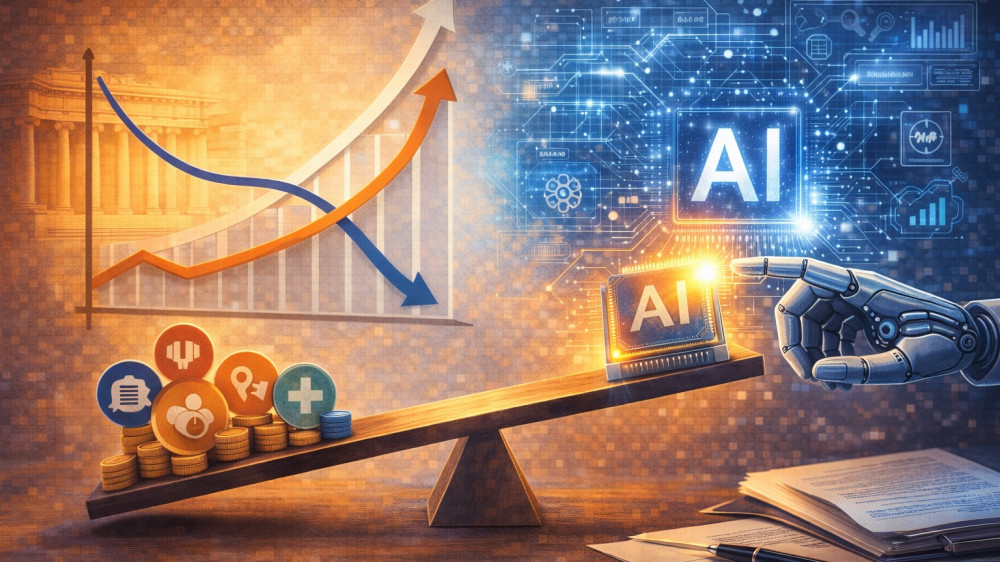
Have you noticed recent market rotations shifting capital from high-valued AI stocks to sectors perceived as more stable? This phenomenon, known as the "Halo-Trade" (Heavy Assets, Low Obsolescence), is a short-term reaction that can increase volatility in leading AI stocks. But for you as a long-term investor, it's crucial to understand that this doesn't signal the end of AI's investment potential. Instead, AI continues to anchor itself as a core technology theme, driving value creation far beyond a few big names. Think of it like the difference between a temporary market shift in the U.S. stock market and the enduring growth of tech giants like NVIDIA or Microsoft—AI remains a central force for productivity and infrastructure investment.
Advertisement
The Halo-Trade is a response to specific market conditions, not a long-term trend. When AI stocks face high valuations and volatility due to earnings reports or regulatory news, investors often temporarily move capital to sectors like physical infrastructure, commodities, or consumer staples—similar to how U.S. investors might rotate from tech to utilities during uncertainty. This rotation doesn't reflect AI's economic potential; it's just a short-term preference shift within equity markets. For you, the key is to see past these fluctuations and focus on AI's role in transforming business models and capital flows over years.


For you, the volatility in AI stocks is heightened by the diversity of business models. The market increasingly distinguishes between companies that convert AI spending into recurring revenue and those with unclear monetization. This differentiation matters because public attention often focuses on a few big names, but the AI ecosystem is much broader—spanning hardware, infrastructure, data, and software layers. Think of it like the U.S. health insurance market: just as private insurance and Medicare/Medicaid serve different needs, AI investments offer varied return profiles across sectors. Fluctuations in leading stocks may dominate headlines, but they don't capture the full value creation from AI investments.
The Halo-Trade can even signal how deeply AI influences capital allocation. When investors rotate portfolios based on AI risks, they implicitly assume AI will reshape product cycles, cost structures, and competition across many sectors—similar to how U.S. investors might adjust portfolios based on healthcare policy changes. This assumption aligns with hard data: the Stanford AI Index Report for 2024 shows record private AI investments and increased business adoption, including generative AI. This shift moves AI from an innovation budget to a regular investment program, affecting infrastructure, data security, and application layers over multiple years.
As a long-term investor, your focus shouldn't be on short-term rotations but on how the AI value chain distributes rewards during industrialization. In early stages, model capabilities and platform dominance were key. Now, as AI integrates into business processes, computing power, storage infrastructure, networking, and security become critical. This shift favors business models tied to recurring budgets and long-term customer relationships—like how U.S. infrastructure providers benefit from sustained demand. Diversifying into infrastructure operators and specialized AI vendors isn't just a diversification idea; it reflects the economic reality that AI spending flows across supply and software chains, not just to a few leaders.
International forecasts support this view. Gartner expects AI-related spending worldwide to exceed individual product cycles by 2026, with infrastructure and foundations dominating. The OECD reports increasing AI adoption in businesses, especially large firms, with diffusion into less tech-intensive sectors. In macro terms, AI is modeled as a productivity and growth driver, as seen in PwC's study on potential global GDP contributions by 2030. These numbers don't replace company analysis, but they highlight the scale of investment and productivity agendas driving demand for hardware, software, and services—similar to how U.S. healthcare spending drives demand for insurance and medical technology.
Advertisement
The Halo-Trade remains a useful term for describing short-term market mechanics, especially when high expectations for AI stocks meet rapid risk reassessments. But for your strategic allocation, it's not an argument against AI's relevance as an investment theme. The structural perspective comes from AI's embedding in operations, infrastructure, and regulation, from a broad value chain, and from investment dynamics visible in international data on adoption and capital flows. Just as U.S. investors rely on long-term trends in healthcare or technology, you should view AI as a central theme for years to come.
Independent professionals are often doers—they shape their work and life on their own terms. And retirement? For that, an efficient and return-oriented retirement plan belongs on your bucket list.